The Valley
Water doesn't stop at a fence line. Neither does wildlife. That's why we think about the whole valley, not just our farm.
Thinking at Catchment Scale
Owletts Farm sits in the Upper Medway valley — a landscape of streams, ancient woodland, farmland, and parkland stretching across the High Weald between Forest Row and East Grinstead. The Shovelstrode Stream winds through it, collecting water from fields and woods before joining the Upper Medway.
When we started looking at our own hydrology, it became obvious that water doesn't care about property boundaries. The stream that floods our bottom field was shaped by what happens upstream. The wildlife corridors that make our restoration work only function if they connect to something beyond our fence. The floodplain we want to reconnect crosses into our neighbour's land.
Nature doesn't respect red lines on maps. If you want to do this properly, you have to think at the scale of the catchment — the whole area that drains into a river system. And that means working with your neighbours.
A Landscape Full of History
This valley has been shaped by people for thousands of years. There's Roman ironworking at Blacklands. Medieval field patterns still visible in the LiDAR. And the extraordinary Hammerwood House — Benjamin Latrobe's first building, designed in 1792 before he left for America to design the US Capitol.
Understanding this history isn't just interesting — it's practically useful. The old maps show us where water features used to be, where the parkland trees stood, where the orchards were. Rolling back the clock turns out to be a remarkably good guide to what the land wants to become again.
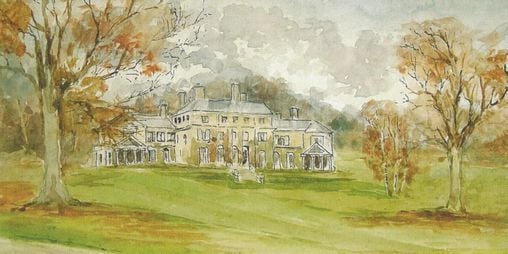
Hammerwood House — Latrobe's first building, at the heart of the valley.
Why Water Matters
Understanding how water moves through a landscape is the key to almost everything else. Where it pools, where it rushes, where it soaks in, where it floods — these patterns determine what habitats can thrive, where interventions will work, and what the land can support.
That's why we've invested so heavily in hydrological modelling — and why we built Ecology App to make that kind of analysis available to others. When you can see the water, you can start to work with it instead of against it.
Full of Potential
The Upper Medway valley is full of farms, smallholdings, and estates — all with their own plans, their own challenges, and their own ideas about what the land could be. We've been talking to our neighbours and finding that there's a lot of common ground. Coordinated action across multiple holdings opens up possibilities that none of us could achieve alone.
More on this coming soon. We're at an early stage, but the conversations are exciting and the potential is enormous.
Interested?
If you're in the Upper Medway valley — or anywhere in the Weald — and you're thinking about nature restoration, water management, or working with your neighbours on something bigger, we'd love to hear from you.